Table of Content
Also, radiation originates from the surroundings and is reflected in the object, and the radiation from the object and the reflected radiation will also be influenced by the absorption of the atmosphere. Some severely immunocompromised persons with COVID-19 may remain infectious beyond 20 days after their symptoms began and require additional SARS-CoV-2 testing and consultation with infectious diseases specialists and infection control experts. Thermal imaging cameras convert the energy in the infrared wavelength into a visible light display. All objects above absolute zero emit thermal infrared energy, so thermal cameras can passively see all objects, regardless of ambient light.
For quick work, a thermographer may refer to an emissivity table for a given type of object, and enter that value into the imager. The imager would then calculate the object's contact temperature based on the value entered from the table and the object's emission of infrared radiation as detected by the imager. If a patient has persistently positive nucleic acid amplification tests beyond 30 days, additional testing could include molecular studies (e.g.,genomic sequencing) or viral culture, in consultation with an infectious disease specialist. CDC’s COVID-19 Community Levels recommendations do not apply in healthcare settings, such as hospitals and nursing homes.
Recommendation for Ending Isolation
Thermal images, or thermograms, are actually visual displays of the amount of infrared energy emitted, transmitted, and reflected by an object. Because there are multiple sources of the infrared energy, it is difficult to get an accurate temperature of an object using this method. A thermal imaging camera is capable of performing algorithms to interpret that data and build an image.
That is, if the contact temperature of a thermally uniform black body radiator were 50 °C (122 °F), the black body would emit thermal radiation characteristic of 50 °C (122 °F). For patients with severe illness, duration of isolation for up to 20 days after symptom onset may be warranted. Images can be difficult to interpret accurately when based upon certain objects, specifically objects with erratic temperatures, although this problem is reduced in active thermal imaging. An ordinary object emits less infrared radiation than a theoretical black body.
Thermography
The fraction of its actual emission to the theoretical emission is its emissivity . The thermal imaging camera would next employ a series of mathematical algorithms. Since the camera is only able to see the electromagnetic radiation that is impossible to detect with the human eye, it will build a picture in the viewer and record a visible picture, usually in a JPG format. These recommendations do not apply to healthcare personnel in the healthcare setting, and do not supersede state, local, tribal, or territorial laws, rules, and regulations. For healthcare settings, please see Managing Healthcare Personnel with SARS-CoV-2 Infection or Exposure to SARS-CoV-2 and Interim Infection Prevention and Control Recommendations for Healthcare Personnel. For more details, including details on certain non-healthcare settings, please review Setting-Specific Guidance.
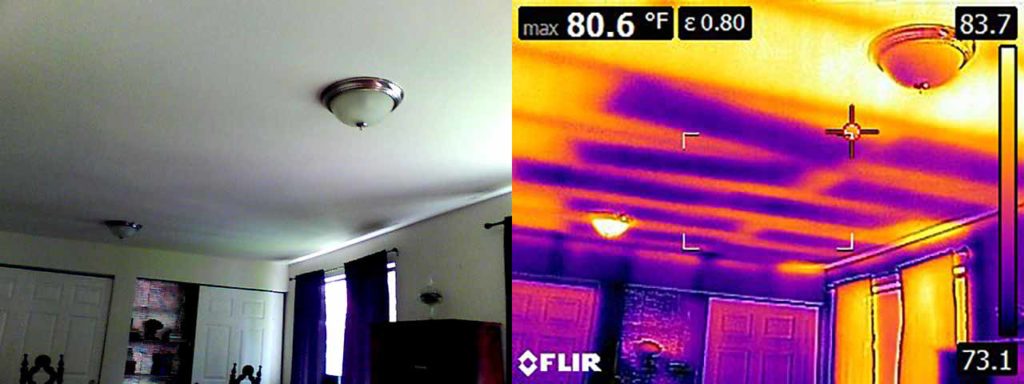
However, most thermal cameras only see objects warmer than −50 °C (−58 °F). Specialized thermal imaging cameras use focal plane arrays that respond to longer wavelengths (mid- and long-wavelength infrared). The most common types are InSb, InGaAs, HgCdTe and QWIP FPA. The newest technologies use low-cost, uncooled microbolometers as FPA sensors. Their resolution is considerably lower than that of optical cameras, mostly 160x120 or 320x240 pixels, up to 1280 x 1024 for the most expensive models. Thermal imaging cameras are much more expensive than their visible-spectrum counterparts, and higher-end models are often export-restricted due to the military uses for this technology. Older bolometers or more sensitive models such as InSb require cryogenic cooling, usually by a miniature Stirling cycle refrigerator or liquid nitrogen.
Applications
Each material has a different emissivity, which may vary by temperature and infrared wavelength. The ability of objects to emit is called emissivity, to absorb radiation is called absorptivity. Under outdoor environments, convective cooling from wind may also need to be considered when trying to get an accurate temperature reading. In certain high-risk congregate settings that have high risk of secondary transmission, CDC recommends a 10-day isolation period for residents. Isolation can be discontinued at least 5 days after symptom onset if fever has resolved for at least 24 hours (without taking fever-reducing medications)and other symptoms are improving. People who are infected but asymptomatic or people with mild COVID-19 should isolate through at least day 5 .

Moderately or severely immunocompromised patients may remain infectious beyond 20 days. For these people, CDC recommends an isolation period of at least 20 days, and ending isolation in conjunction with serial testing and consultation with an infectious disease specialist to determine the appropriate duration of isolation and precautions. Thermographic cameras create thermal images based on the radiant heat energy it receives. As radiation levels are influenced by the emissivity and reflection of radiation such as sunlight from the surface being measured this causes errors in the measurements. Changed the name of the ‘non-test-based strategy’ to the ‘symptom-based strategy’ for those with symptoms. Added a ‘time-based strategy’ and named the ‘test-based strategy’ for asymptomatic persons with laboratory-confirmed COVID-19.
The object's known temperature can then be measured using the standard emissivity. If desired, the object's actual emissivity can then be determined by adjusting the imager's setting to the known temperature. There are situations, however, when such an emissivity test is not possible due to dangerous or inaccessible conditions. In order to make a temperature measurement of an object using an infrared imager, it is necessary to estimate or determine the object's emissivity.

Added new evidence and recommendations for duration of isolation and precautions for severely immunocompromised adults. Added new recommendations for duration of isolation for people with COVID-19 who are moderately or severely immunocompromised. Also, if a moderately or severely immunocompromised patient with COVID-19 was symptomatic, there should be resolution of fever for at least 24 hours (without the taking fever-reducing medication) and improvement of other symptoms. Loss of taste and smell may persist for weeks or months after recovery and need not delay the end of isolation.
Added information around the management of persons who may have prolonged viral shedding after recovery. Color contours of temperature for a smoldering ember measured with a CMOS camera. Some cameras may only have a refreshing value of 5 –15 Hz, other (e.g. FLIR X8500sc) 180 Hz or even more in no full window mode.
By using the proper camera settings and by being careful when capturing the image, electrical systems can be scanned and problems can be found. People who are moderately or severely immunocompromisedshould isolate through at least day 20. Use of serial testing and consultation with an infectious disease specialist is recommended in these patients prior to ending isolation. In order to get a more accurate temperature measurement, a thermographer may apply a standard material of known, high emissivity to the surface of the object. The standard material might be as complex as industrial emissivity spray produced specifically for the purpose, or as simple as standard black insulation tape, with an emissivity of about 0.97.


No comments:
Post a Comment